Funded by an Improvements in the Administration of Justice grant from FFLA, United Way of Indian River County’s Self Help Center legal kiosks have benefited nearly 4,000 parties in need
By Makayla Archambeault
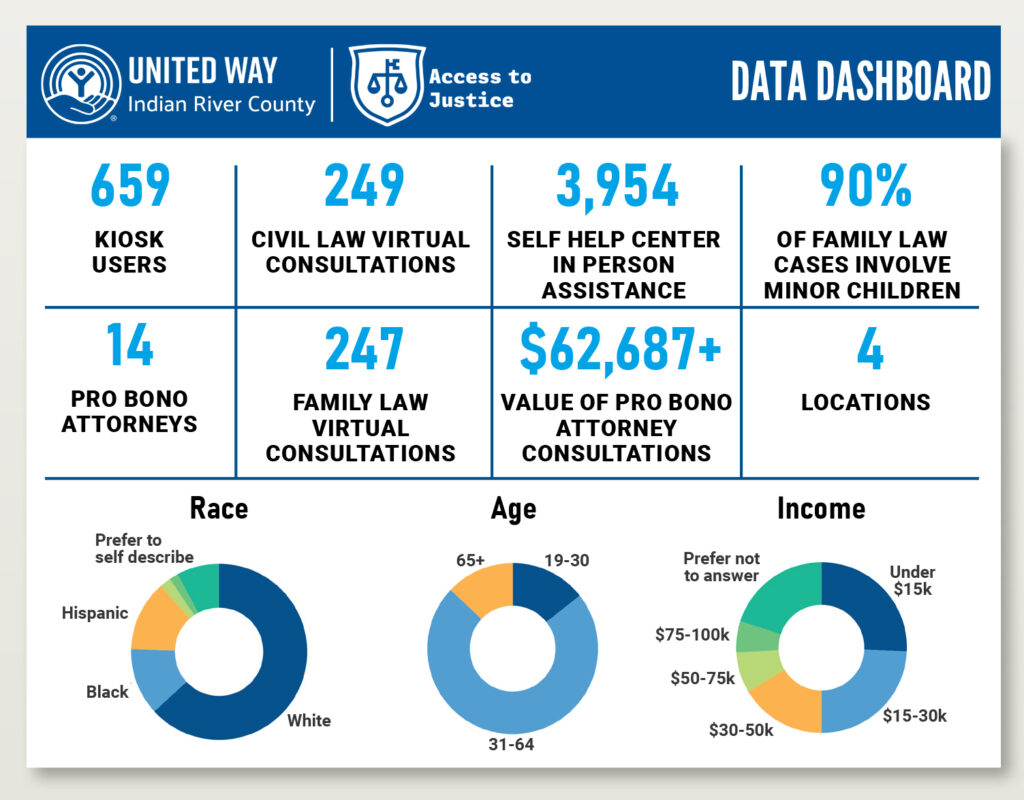
Opened in September 2023, Access to Justice (A2J) Self Help Center legal kiosks have been groundbreaking in Indian River County (IRC). The kiosks offer free civil legal advice and services for individuals unable to afford an attorney. A2J is an initiative of the United Way of IRC in collaboration with the Clerk of Court, the local judiciary and county government.
The kiosks have improved local community members’ access to justice through increased support hours and resources. FFLA funded almost half of the legal kiosks project.
After two opened in 2023, two more locations were added in August 2024. Three of the remote legal kiosks were launched strategically around IRC to supplement the primary courthouse site and meet the needs of underserved communities.
“The success of these legal kiosks reflects that cooperation and innovation can extend legal aid to areas not previously served,” FFLA Executive Director Donny MacKenzie said.
Additionally, clients can access the same resources online any time at www.a2jirc.org. Kiosks provide legal forms for family law, small claims, and residential law, which can be sent directly to a supervisor for review.
As of February 2025, the program relieved Self Help Center customers of more than $57,000 in legal services and fees they would not have been able to afford otherwise.
“Our unique combination of legal kiosks, bilingual navigators embedded in the courthouse, and virtual attorney consultations has enabled us to serve nearly 4,000 self-represented parties,” United Way of Indian River County CEO Meredith Egan said.
The impact of the program is evident, especially in cities like Fellsmere.
“Fellsmere is a small, rural, under-resourced community in Indian River County. The median age is 32 years old, with a household income of $28,000 and a poverty rate of 18.9%. Education data indicates that 37% of the residents have no degree, and only 31% have earned a high school diploma,” IRC County Commissioner Susan Adams said.
“The roadblocks to those seeking help are obvious. This is a hardworking community and residents must work to support their families. When faced with legal
issues, taking time off to address them or navigate the system for answers is almost impossible.”
The program hopes to expand to offer more legal help to the citizens of IRC and beyond.
“Our innovative approach has caught the attention of other communities within the state, as well as programs across the country, all eager to learn how we’ve built such a unique service for our community,” Egan said.
“As we enter our second year of service in IRC, the demand for services has grown. However, we are confident that with our expanded site locations and additional staff, we can continue to meet the growing demand for this program.”